Wednesday, October 12, 2011

NanoWrimo 2011


We're almost halfway through October, meaning it's almost time for NanoWrimo - or National Novel Writing Month! Each year, the worldwide contest requires those daring enough to complete a 50,000 word draft in 30 days. There's no monetary reward - just a certificate you get to print out and hang on your wall, and most importantly, the rough draft to a complete novel.

I've participated in NanoWrimo for the last 6 years now, completing it each year. During most years I end up completing the 50,000 word count by the middle of the month, so this year I decided to turn things up a notch. I'm going to use NanoWrimo to complete the final two books in my Black Earth series. So by the end of the challenge this year, I will have a pair of 50,000 word manuscripts ready to be embellished, polished, and sent off to my editor.

If you're participating, or you just want to check out my progress in November, head over to my profile at the official NanoWrimo website and friend me. ;)

Friday, October 7, 2011

The End of Black Earth


For months now, I've been working on my current WIP (Work in Progress): Dark Horizons, the third novel in my Expired Reality series. My original intention was to release the first three books in the series in a row, one a month, this last summer. The first, Endangered Memories, has been released, with the second, Lost Birth, coming out of the gates hopefully next month.

Even though I'm about 75% through a rough draft of Dark Horizons, I can't shake the feeling that it's not the project I should be working on at the moment. Once my son was born at the end of August, my writing time vanished for a while. With weeks of no writing, I've had a creative build-up of sorts, and I have a HUGE desire to finish up the Black Earth series.

My original intention was to bounce between the Expired Reality series and the Black Earth series while alternating book releases within each series. As good as that idea seemed a while ago, it doesn't seem to be panning out too well now. I have fans who want to see what happens with Black Earth and for them to have to wait while I finish books in another series is kind of lame. Besides, my Expired Reality series is going to run almost a dozen novels, if not more, so I'd like to give that series 100% of my time and effort instead of bouncing between it and the Black Earth series.

All this said, I've decided to finish off the Black Earth series. My original intention was for the series to run about 4-5 novels and in keeping with that, I'm going to do two more books and close the series off.

Coincidentally, next month is National Novel Writing Month, or NanoWrimo. (Check out www.nanowrimo.org to see what it's all about.) Seeing how I have a lot of writing to do with two books, I'm going to use NanoWrimo to do so. I usually complete the 50,000 word limit early on in the month of November anyway, so I'm just going to do my best to complete two, 50,000 word manuscripts for the contest this year. Then I'll polish them up and hand them off to my editor after the new year.

Keep tabs on this blog to find out more about the next two Black Earth novels. I'll be posting plot ideas, writing samples, and some character profiles as I get into the thick of it. 

Friday, September 23, 2011

Baby Nolan


I know I've been out of the game for almost a month now, but on August 23rd, my son, Nolan Bailey Alderman, was born. Since then it's been a bit of a whirlwind. All my expectations of what I thought fatherhood would feel like went right down the drain the moment my baby boy was in my arms. What an incredible blessing!

That being said, it's been a challenging couple of weeks. My wife went back to work last week and this has left me home with Nolan most of the day. Last week I mistakenly tried to balance work and baby and it blew up in my face. This week seems to be going a little bit smoother.

I'm glad to be getting back into the swing of things. In the next couple weeks I am going to be reevaluating my project lists and some of my marketing strategies, so news of those changes will come through here. After today though I'll be moving a lot of my talk of baby Nolan to my other blog - http://www.ofdreamsandfaith.blogspot.com - to keep this one focused on writing and self-publishing.

Tuesday, August 23, 2011

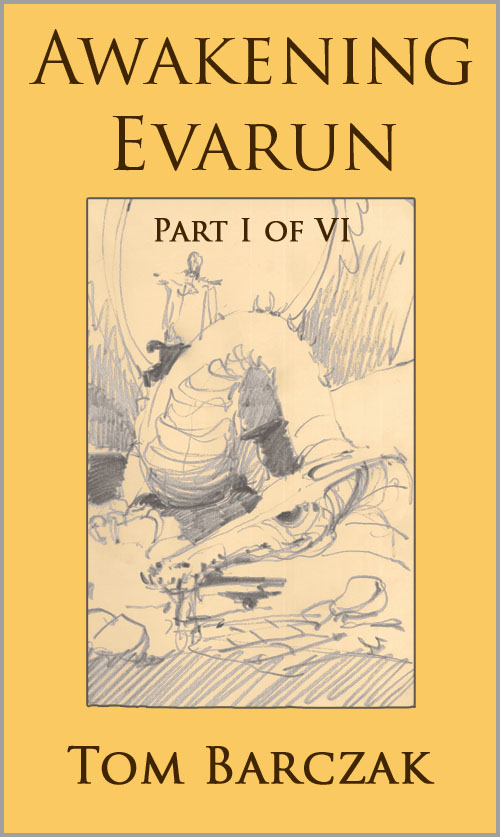
Awakening Evarun and the Appeal of Short Story Series


I recently had the honor of reading the first installment in Tom Barczak's new short story series, Awakening Evarun. If you've never heard of Tom Barczak, I can understand. Awakening Evarun is his first 'published' piece of work, but I found this debut piece of fantasy to be quite entertaining.

I had the opportunity to speak with Tom on the phone a while ago and we had a chat - author to author - about how we found the idea of short story series to be quite compelling. I think in this age of self-publishing, with authors having control over every aspect of their work, it's neat to think in terms outside just writing novels.

I've always been a huge fan of the Star Wars universe. Although I love the writing of most of the authors that are given the privilege to write books in the series, I have always been more enamored with the simple aspect of diversity. The Star Wars universe started with a group of main characters and has branched off into a whole universe of fictional goodies. Novellas, short stories, cookbooks, merchandise, novels, movies...the list goes on and on. It's easy to pick up a book and read it, understand what's going on, and want to dive into other parts of the universe.

This delightful appeal is one I have aimed for in my own series

I've had plans in the works for a couple years now to start an episodic short story series called the LZR Project. I have five or six drafts of episodes done already and am hoping to resurrect this project and start writing on it again this next year. I did the episode thing with my novella, Picture Perfect, before I combined the episodes into book format. I just like the idea of readers being able to bite off little chunks of a grander story here and there, weeks or months at a time. It's a nice diversion to keep my readers entertained while I continue to carve away at the novels, which take considerably more time and effort.

In that regard, when Tom told me he was wanting to try out this short story episode idea, I was excited. Especially considering he is also a talented artist who is illustrating parts of these stories.

Check out the first installment of Awakening Evarun if you get a chance. It's well worth the $2.99. Below is my review.

Awakening Evarun is a great start to what Tom plans on being a six-part short story series. The pace of the story is easy and intriguing, making it a quick read that feels satisfying, yet leaves you wanting more when you're finished. Tom's writing style is definitely a gift and I look forward to more from the author.

On top of that I have to praise the illustrations. It's not that often you come across an author who can also illustrate his stories with such great detail. It's also not that often you come across an illustrated story as this. What a treat. For the price, you get great artwork and an intriguing storyline. Tom Barczak is definitely an author to check out. 


Purchase Awakening Evarun on Amazon -  http://tinyurl.com/4x3th44
Tom's website - http://www.tombarczak.com 
Tom's blog - http://www.tombarczak.com/blog
 

Friday, August 19, 2011

Chronicling A Legacy


As I write this post, my wife and I are still patiently waiting for our son, Nolan Bailey Alderman, to be born. He's actually not due until August 26th, but it feels like we've been waiting for years for him to come out of there.

In the meantime, I've found something productive to do that will hopefully benefit my coming son, and me. I've started a handwritten journal where I am going to detail the walk that my wife and I have taken with God these last few years - along with the adventures I've experienced during my lifetime. Hopefully I can drop some gems of wisdom throughout the journal and help my son to learn from some of my mistakes. Hopefully he can marvel at the outrageous things I did in my youth, and appreciate the incredible steps of faith I've taken as an adult. Hopefully he can benefit from the one story I haven't fabricated - couldn't have as big as my imagination is.

Someday, this journal will be considered a relic. I figure the art of hand writing anything seems to be getting more and more lost as we enter the digital age. I'll admit, I'm succumbing to the convenience that computers and smartphones offer. But there's just something ten times better about getting something handwritten rather than getting something typed out or preconceived. A poem, rather than a pre-typed greeting card. A letter, rather than an email. Heck, my grandfather and I write each other and he even keeps to the old tradition of sealing some of the envelopes with wax.


A bygone art that needs to be appreciated more.

I'll give this journal to Nolan someday in the future when he's grown enough to understand - and hopefully appreciate - all that's written in it. In the meantime, I have an adventure to write.Or rather, record.

Monday, August 8, 2011

Waiting...

The other day the doctor said our son could come any day now, even though my wife's due date isn't until August 26th. Being so close in proximity to the due date of our first child, I haven't been able to keep my head screwed on straight in regards to anything writing-related. That's not to say I'm panicking or anything - I feel quite ready for our kid to come - but it's to say that my focus has been a bit scattered. I've been helping my wife get the apartment ready for the baby while also getting our insurance matters in order, things that have been pulling the majority of my attention away from writing. When I do get a chance to sit down and write, all I can think about is the baby coming.

Oh well. I'm sure my creativity will refocus itself once little Nolan Bailey Alderman is with us. Any day now... :)

Tuesday, August 2, 2011

Is Redemption Always Expected in Christian Fiction?


I received another two star review a couple weeks ago, this one for the second volume in my edgy Christian speculative fiction series, Black Earth: The Broken Daisy. The review as a whole wasn't the most positive I have received, but there was one major thing that really stuck out to me - the reader's disappointment with the direction one of my main characters is going in the series.

In the same reviewer's honest analysis of the first book in the series - Black Earth: End of the Innocence  - she made complaint that my character, Cynthia Ruin - or Sin to her friends - hadn't found complete redemption by the end of the book:

"Also disappointing was the story line for Sin. I would have liked to have seen her evolve more, and truly regret her actions. It felt like she started to regret them a little, but never truly asked God to forgive her."

Aside from me pointing out that this is a series, and that character development, including themes of redemption, can be spread across multiple volumes, I would also argue that, as in real life, people don't always turn to God once something doesn't go their way - if at all. And just because one has accepted Christ, that doesn't mean there isn't a tough road ahead, or that the individual in question isn't going to stumble or backslide along the way to complete redemption. Some may not even make the complete life change that God plans for them. It's sad, but it's a reality.

In the review for the second book in the series, this reviewer continued to voice her frustrations with Cynthia's character development:

"I had hoped to see Cynthia really regret her bad behavior and find redemption, she was leaning towards that at the end of book one, however she ends up seducing Nathan and not regretting anything."

My intention isn't to argue with the review itself. These were the reviewer's honest opinions and she's entitled to them. I appreciate her taking the time to do the review. The comments I highlighted do raise an interesting curiosity for me though. In fiction - especially Christian fiction - has it become expected of the characters to find redemption and turn to God for their answer to life's meaning? I mean, is it a matter-of-fact expectation for the majority of characters involved?

I'll give a bit of background on my character in question: Cynthia Ruin. The first book in the series opens up on the night of her high school graduation, an even which she vehemently opposes. Instead of participating, she instead opts to spend time in a local night club. Throughout most of her high school life, Cynthia is inconspicuously known as the Pink Rabbit, a high school slut who sleeps with and does favors for the guys of her school. With each favor she performs, she stamps a pink rabbit on the body of the male giving him a particular status symbol around the school. It's even rumored she has done favors for hand-picked females.

In other words, this isn't a character your mother would want you to bring home. But that's Cynthia Ruin. Cynthia is raped the night of her graduation at aforementioned night club by an angry individual who was once turned down by the Pink Rabbit. Rejection is a powerful drug that can make many do things they wouldn't otherwise do.

Throughout the story, Cynthia begins to regret her actions. The rape endured at the night club strikes fear and vulnerability in her and causes her to question why she does what she does. But she isn't exactly ready to embrace a loving God. Not just yet.

Cynthia eventually crosses the path of the main protagonist of the story, Nathan Pierce, who is a born-again Christian but struggles with his own ideals of religion and faith. By the end of the first book, Cynthia redeems some of her actions by saving someone's life, but this still doesn't bring her to a point where she's going to drop to her knees and worship God.

I don't want to spoil too much of the story, but in the second volume of the Black Earth series, the world falls into darkness and because of this, Cynthia reverts to her old ways of dealing with life - drinking and sexual promiscuity. She sees Nathan - a Christian - as a personal challenge that needs to be broken of his proclaimed virginity. So she seduces him, claiming that there is no need to hold on to morals or values with the world ending, and they have sex.

It isn't until the end of the second book that Cynthia starts to really have a desire to clean up her act. But even at that point she still doesn't come right out and seek forgiveness for deeds.

So this brings me back to my curiosity: In fiction - especially Christian fiction - has it become expected of the characters to find redemption and turn to God for their answer to life's meaning?

Maybe not all the characters? Any? Isn't the point of Christian fiction to be inspirational, to showcase themes of redemption. Maybe the point is to reveal the character of God to a fallen world. Maybe it's to entertain? I guess it all really depends on your storyline and your characters.

Isn't it a bit presumptuous to assume that characters in Christian fiction - or even those we know in real life - are always going to see things the way we see them, or even how God sees them? This is a fallen world - as is the world in my novels. Darkness overshadows the land, filling it with murder and hate, destruction and chaos. Vices run rampant - sex, drugs and alcohol, among dark and deadly things. But in the world we live in, and my fictional world, there is also light and redemption and salvation. Although, not everyone wants to take hold of such things. Especially in a world falling into darkness, many simply want to party until the planet implodes. Such as in life, evil does win sometimes, and good isn't always accepted by those we love.

So, I'm wondering if some people just automatically expect happy turnouts for the characters in the stories they read. At least in Christian fiction. Who knows what direction Cynthia will go in the third volume? She may end up becoming an anti-hero. She may turn into the story's greatest villain. Or she may just wander through the darkness, ignoring the light altogether.

And it's in watching Cynthia wander that some of us open our eyes and notice those around us who are wandering just the same.

Hmm.

Friday, July 22, 2011

Welcome Home Books, Goodbye Borders


Before I get into my experience with Borders, I want to clear one thing up. I'm not trying to complain or vent about not receiving payment for a few books. I don't think the world needs to be turned upside down for such things. This is simply my experience and the way I handled it. As a self-published author, I know I am going to take losses sometimes. I just figured I'd share my slice of experience with others.

I took a field trip Wednesday night to my local Borders book store. No, it wasn't to purchase stacks of books before the company goes out of business. I already have stacks of books sitting on my desk that still need to be read. No, I went down to my local Borders to pick up the remainder of my books that haven't sold in the last eight months.

See, I did a book signing in their store in December 2010. The store 'purchased' ten books from me to put on their local author shelf. I was pretty excited at the time. Ten books is a big sale and the sales manager told me Borders would pay full price for my books - which is unheard of by the way. Usually big name bookstores as such will purchase books at a discount, sometimes even bringing a self-published authors bottom line into the red. My sales for this transaction were supposed to come to about $145. Not too shabby for ten books.

Only problem is I never saw any of that money. Zip. Zero. Zilch. 0.

I gave the sales manager an invoice a few days after the signing and she then sent it on to Borders corporate or wherever the invoice goes to be paid. Months went by and I heard nothing. It wasn't the sales manager's fault. She said she contacted Borders corporate and sent my invoice, as I would have expected her to. It was Borders who dragged this out.

Months later I heard that Borders was going to shut down some of its stores and file bankruptcy and I panicked and contacted the store to see if I could get my unsold books back. Each book costs something out of my pocket, so if a store that had my books - and hadn't paid for them yet - was going to go out of business, naturally I wanted those books back. The sales manager told me her store was going to stay open but if I wanted my books back she would comply. I thought about it and leaned toward the realization that it might be more beneficial for my books to have the prime real estate that a major book store chain offered rather than have my books sit on my own shelf here at home and collect dust. I told her I would be patient, at least for a little longer.

More months went by. I sent another email to the sales manager requesting information regarding my payment.
She said she was waiting to hear word back from corporate on when I would receive my check. So I said I would be patient still.

Word broke out on the internet a couple days ago that Borders was in the process of liquidating. I sent an email to the sales manager telling her I wished to get my unsold merchandise back, seeing how I hadn't been paid and didn't see any payment in my future. She understood and suggested I came to the store to do it before they got put in the liquidation pile for this coming Friday.

Considering I only sold three books and had seven to pick up, I figured I'd just call the three books a loss. Well, monetary loss. Not really a loss loss. Three more readers - at the very least - have my books out there somewhere. My stories, out in the world, held by complete strangers. That's got to be worth more than the purchase price of the books, right?

When I arrived at the bookstore, the sales manager gave me a printed out email history that detailed the conversations she had been having with Borders in regards to my payment. Essentially, Borders said my book 'sales' to them were pre-petition debt and that legally they couldn't pay me even if they wanted to. I asked what the legal mumbo jumbo meant and the sales manager told me that because I 'sold' Borders the books before they filed bankruptcy, that the sale is protected under bankruptcy law and I have to go through bankruptcy proceedings to get paid for the three that were actually sold.

Yeah. I'm not all that sure it's worth my time to go through the hassle to get my money from those.

Don't get me wrong. I've had a number of good experiences with Borders in the past. This last issue though wasn't the first 'bad' experience I've had with them. Last year, I had a couple stores in Tucson request physical copies of my books that they could review before setting me up with store signings and I never heard back from them. Neither of those sales managers would even see me in person when I dropped off the books, even though they were in store and their store was an hour and a half from my home.

There was another local Borders store manager who said to me he was in talks with his sales manager to set up a date for me to do a store signing. After a number of emails requesting the date, I realized he had decided to simply ignore me and hope that I would go away like a pesky fly nobody wants at their picnic. No signing was ever set up. The year before that, I had a great signing in that store. It was when the management got changed that I had the communication issues.

These experiences are the main reason I try to stick with the local indie bookstores, mainly Bookmans. I get paid right away, I don't get ignored when I request signings, and they fully support self-published authors.

Oh well. Live and learn. My experience with the the Borders sales manager in the case of my missing payment was positive. I'm sorry to see such good people lose their job positions. C'est la vie. I do wish her the best of luck.

At least my books are back and ready to find new homes.

Wednesday, July 20, 2011

To Be or Not To Be - Edgy Christian Speculative Fiction


When I originally started writing the first book in my Black Earth series, End of the Innocence, I vaguely referred to it as a Christian sci-fi/fantasy novel. In the book, some of the characters are of the Christian faith and there are some faith-based themes that run throughout. After a while though, I kind of fizzled out the idea of labeling my work as Christian fiction, mainly because I felt there was some edgy content that just wouldn't make it very far in the Christian fiction market.

In a 2-star review that was recently given to Black Earth: End of the Innocence, the reviewer commented on how she was puzzled why the book's description or at least the genre it was classified in didn't clue her in that the book was Christian fiction. I get the feeling she thought she might have been tricked somehow, but that wasn't my intention. I'm not here to wrap a sermon in a story. I simply want to entertain others with my fiction. The old adage, write what you know, is exactly why I have some characters that are of the Christian faith and I have some of my themes lean more toward an all-powerful, loving God and His relationship with creation.

Aside from the negative review, I have also received many positive reviews, some commenting on how happy they are to have found some science fiction with Christian themes, or Christian fiction that isn't corny.

All these references to Christian fiction have caused me to pause and think. What exactly is Christian fiction, and does my work fall into the category?

I think Christian fiction has come along ways over the last few years in developing more entertaining stories that can appeal to Christians and non-Christians alike. Some readers view Christian fiction as Amish 'bonnet' stories that are found gracing the shelves of most Christian bookstores. Others refer to Ted Dekker, Tosca Lee, Frank Peretti and Tim Lahaye when the word Christian fiction is mentioned. Some readers even shake their heads when they hear the genre label because they envision a preachy sermon wrapped in book binding.

And I guess that's where I've been at a dilemma.

See, my stuff isn't exactly appropriate for the typical, mainstream Christian fiction market. There are sexual scenes, there is violence, and there are curse words in some of my stories. Aside from those issues, there are alien races, other planets, time travel and other realities...many things that some Christians don't believe should be considered Christian fiction, let alone things that Christians should be writing about in general. Science Fiction/Fantasy and Christian fiction always seems to be at odds with each other, with very few authors taking the risk to bring about the genre mix.

So, since some of my writing has the makings of an R movie, that means it falls into the mainstream fiction slot for sci-fi/fantasy, right?

Not necessarily.

I've been trolling the Amazon forums here and there to see what readers have to say about self-published writers and their behavior online. I've run across more than one forum that discusses how readers thought they were 'tricked' into reading what they thought was a mainstream novel only to find it was a thinly veiled Christian sermon. Some of these acts of trickery I have found to be quite intentional on the author's part. That just gives Christians and Christian fiction a bad rap.Some of those instances aren't all that intentional though. I venture to assume there are other writers like myself that wonder what side of the fence their fiction lies. Although I don't feel I have the makings of a sermon in my stories, they do contain faith-based themes.

Now before any of you leave me a comment to tell me that genre really doesn't matter, it does. It matters a lot. The genre our fiction falls into determines the demographic we are going to market to, the categories that Amazon.com and Createspace are going to drop us in, and will even influence the direction our blog and other social networking endeavors will go. Genre is a sort of target you put on your work so others can see where it really fits in the scheme of things.

Those of us who do write really edgy Christian fiction - and I have no idea who else is in the same boat as me in regards to this - are in a Catch 22. If we say we're mainstream, we get criticized for our religious/spiritual content. If we say we write Christian speculative fiction - let alone edgy Christian speculative fiction - we get criticized by certain Christian circles about how inappropriate the content in our novels is.

*sigh*

What really breaks the dilemma down into a manageable issue is another question. "Why are we not marketing our books for what they really are?". Is it just because we're afraid of criticism? Afraid of the hot debate that might ensue if we show a bit of violence, a steamy scene, or a bit of crass wording? Don't get me wrong, I don't believe these things need to be overdone for them to work in a story - whether that be a Christian story or a secular story - but I do feel they have their place in fiction.

Moving the debate on what is or isn't appropriate in terms of Christian fiction on the back burner for the moment, I'll address my quandary from a strictly marketing point of view. Regardless what genre our book falls in, if we don't market our book as such, we're losing out on the readers who enjoy that specific genre. As narrow as that crowd may be, they should be the first that we reach out to try and gain attention for our books.

Now I know many Christian fiction writers don't want to be labeled Christian fiction writers because we want our work to be read by non-Christians, and the term Christian fiction can sometimes hold a certain expectation. I have a friend who approached that question with a really good answer. He said he markets to Christians, because that is his general audience, and those Christians, once they have experienced his work, pass it along to those who may or may not be Christian who might like the material. My friend relies on word-of-mouth to relay his work to those who would enjoy it. That's really what marketing is all about, at its core, isn't it?

Well, enough monologuing. Here I go. For those who want to know, for those who care, I'll step out and call my work for what it really is:

Edgy Christian Speculative Fiction.

For those who write/appreciate this sort of genre, drop me a line and lets work together to get works of this nature out to those who enjoy their faith-based fiction with a bit of bite and a bit of the fantastical. :)

Wednesday, July 6, 2011

The Best Way to Embrace a Negative Review


Now that self-publishing has taken off like the California Gold Rush, the internet - and bookstores - are booming with self-made creations of literary wonder. Because of this, it's tougher for the readers out there to sift through the mess to find the gems that they will eventually fall in love with.

What is a self-published author to do? How do we rise above the crowd and make ourselves - and our books - stand out? One way is by reputation. Reputation encompasses many different aspects: our attitude toward others online, our involvement in social networking, the quality and content of our books. Reputation is important because without it, people don't know who we are or sometimes even what we do.

One way we establish reputation for our work is through reviews. Reviews are like gold to a self-published author. They give our work weight and legitimacy, and they give the readers out there a - hopefully - honest opinion about our work.

Good reviews are always desired, but what do we do when we get a negative review? How do we react when someone digs into our work with a diamond-plated shovel and pulls everything out only to tear it to pieces in front of you and the watching public?

We take it in stride.

As authors, our online - albeit public - presence is our reputation and our platform. Meaning anything we say or do, any way in which we react with others, adds to the whole definition of who we are to others. Because of this, we can't afford to explode or throw a temper tantrum when someone says something critical - or even outright negative - about our work.

I'll give a very clear example - which most of you might have already seen - of how not to handle a book review. Below the review is a string of comments from the author, blowing up and defending her work, claiming the review was unfair and unjust...

http://booksandpals.blogspot.com/2011/03/greek-seaman-jacqueline-howett.html

The author of the book reviewed had a complete meltdown when she found out here book was only reviewed with 2/5 stars. I'm not implying her actions should be mocked, but simply used as an example of how not to react to an honest review.

On the other hand, I recently received a 2-star review for my novel Black Earth: End of the Innocence.

http://topublishornotto.blogspot.com/2011/06/indie-book-review-black-earth-end-of.html

Did I blow up at the reviewer? No. Did I argue with the reviewer, citing defenses to shield my work from negative opinions? No. I graciously sent her an email, thanking her for her time. You know why? Because it was her time that was spent reading and reviewing my book. Do I agree with the 2-star review I received? Doesn't really matter. The review isn't for me, it's for the readers.

In that regard, I have a few tips on how to handle a bad review, if you happen to be one of the lucky few who get one. ;) I am by no means an expert, but I think holding your head high and being respectful of everyone online can go a long ways in this business.

First -  Understand that a review is simply an opinion. Everyone in this world has opinions, and reviewers are expected to proclaim theirs. That's the point of their position. If a reviewer hates your novel, so what? Others may enjoy it. Maybe your book just isn't someone's cup of tea, and that's fine.

Second - Did you request the review? And if so, did you request the review from someone who enjoys books in your genre? I've seen it happen - an author requests a review for their sci-fi/fantasy novel from someone who usually reviews romance books. Odds are, you're not going to get a lot of interest for your material from that reviewer, so make sure to search out reviewers who review in or at least close to your genre.

Third - Every review is a potential opportunity to grow. As much as reviews are people's opinions, they may very well hold learning merit. If a reviewer is complaining about your bad grammar or inconsistent dialogue, then take a moment to look over those items in your work - especially if others have pointed out the same things.

Fourth - Understand that reviewers are taking their time out to not just review your book, but to read it. There are thousands upon thousands of self-published books out there now, and sorting through them to find ones of interest to read is a task unto itself. Those readers then take the time to actually read said book and then to write an in-depth, detailed review. All of that takes time out of a reviewers personal life and time away from others who are waiting in line to be reviewed next.

Fifth - Any news can sometimes be great news. What do I mean by that? Sometimes even a bad review can garner the same - if not more - attention to your work than a good review. I know there are many readers out there that actually skip over purchasing a book on Amazon because the book has numerous 5-star reviews attached to it. The reader wants honest reviews, and even a critical 1 or 2-star review can really build your book into something that is going to catch a reader's eye.

Always remember these simple principles when getting a review, good or bad:
  • Always thank the reviewer for their time.
  • Never defend the review, no matter how harsh it is. The review isn't for your ego, it's for the readers out there.
  • Promote the review to gain attention for your book. This includes asking the reviewer to post his/her's review in as many online locations as they can. Including Goodreads, Amazon.com, Barnes and Noble, Library Thing, etc.
  • Don't request a review from someone if you're not willing to have that review posted everywhere. There are authors who ask to have reviews taken down because they are just too ashamed of them. Don't do that. It's immature and it makes the reviewer not want to deal with you - or self-published authors - in the future.
There are still remnants of a negative stigma attached to self-publishing that many of us are trying to hurdle over. Don't make things worse by blowing up or tearing a reviewer apart just because they were critical of your work. Be mature. Be an author worth checking out, not one that readers want to run from because of your bad attitude. Give the reviewers who are taking their time to read your stuff a pat on the back so they'll continue to read and review self-published work.

Photo credit - Creative Donkey