

Showing posts with label End of the Innocence. Show all posts
Showing posts with label End of the Innocence. Show all posts
Friday, December 7, 2012
Start At The Beginning...


Thursday, October 18, 2012
Super Powers and Magic in Christian Fiction

The Bible is very clear about God's stance against divination, witchcraft, or sorcery, but the Bible also promotes the gifts of the Spirit. I'm not promoting divination or sorcery. I'm not promoting witchcraft or other satanic taps into the spiritual realm. But what if instead of just spiritual gifts - such as love, peace, paticence, kindness, etc - God granted humans special powers, almost magical in nature, both to defend from and attack the forces of evil? It's an interesting concept that can easily be explored within the boundaries of fiction.
When I was growing up, magic was heavily frowned upon in all forms of entertainment. Magic was, by default, assumed to originate from Satan himself. Mirrors were evil portals that stole people's souls, magic wands were the devil's utensils, and viewing anything to do with witchcraft had the uncanny ability of turning viewers into witches or warlocks themselves. Now, it's true that much of the magic I experienced through screen or books growing up did have strong elements of witchcraft and the occult, which is clearly in opposition with Christianity.
Our culture has changed somewhat since those days, though. Harry Potter brought the theme of magic into a more innocent and dazzling realm, showing how magic could be used against the forces of evil as well as originating from them. Although if one stretched it, one could find minor themes of occultism in the Harry Potter films. That's probably one reason why everyone went up in arms over the movies when they first come out, because young folk can't always discern between fantasy and reality. But the themes weren't strong enough to cause kids to go out and begin chanting to the devil to have him grant them special incantations.
In the same token, super powers have grown wildly popular with the slew of super hero movies that have graced the screen and comic book shelves in recent years. Maybe there's just a feeling of heroism going around lately. Strangely enough, super powers were never frowned upon the same way magic was while I was growing up. Maybe there's just something more innocent about a man in a cape flying through the air, shooting lasers out of his eyes than there is with a decrepit old woman sailing around on a broomstick shooting magic beams from her wooden stick.
In End of the Innocence, the first novel in my Black Earth series, Heather Rhodes realizes she has the ability to create a shield or barrier made of light. She questions this ability at first, wondering if it is something Satan has granted her. Little does she know it is a gift bestowed upon her as a Wedge, triggered when she hit puberty, the time when all Wedge gifts become apparent. Later in the series, it is revealed that Wedges believe their powers are bestowed upon them by the Ravencroune, a sort of deity among Wedges, when in fact it is God who has bestowed the gifts upon them and the Ravencroune is simply a mortal worshiped for her martyr death.
Throughout the series, Heather uses her light shield to protect herself, her friends, and other innocents from Legion's dark attacks. She uses the power for good. But what if she were to use it for evil? What if she were to use the gift for other means - either to protect evil minions, or protect herself after committing heinous crimes? What if she could find a way to use the light shield to harm others?
The parallel here is that God has given everyone specific gifts. Yes, He doles out and cultivates fruits of the Spirit, but He also gives us gifts. The gift of writing, of eloquent speech, of technical prowess. Some of these things come naturally to us, others are traits or skills that we have to work harder to perfect, but benefit us and others in the long run. Translating gifts to fiction and terming them as powers or magic isn't too much of a stretch.
And each character is given the choice to use these powers for good or evil, just as each of us are given gifts to use for the Kingdom, ourselves, or the powers of darkness. It takes discernment to look at something and decide if it has origination in darkness or light. I already discussed something close to this in my post about entertainment and exploring great movies for the themes they present, even if they might have content questionable to Christian prudes.
In fiction though, I think magic and super powers and the like can be conveyed in a meaningful and responsible way that portrays evil for what it is, good for what it is, and fantasy elements for what they are.
I was going to add Heather's profile to the Compendium on Friday, but I'm a little behind on my design goals, and the Compendium's new look won't be ready until next week. So her profile will go up sometime next week. I'm also going to be running a side series next week that explores the last 7 years of my NaNoWriMo adventures. Each of 7 posts will explore the projects I did for NaNo each year and maybe give some hints as to where these projects fit into my writing portfolio in the future.
Tuesday, October 16, 2012
Black Earth Character Spotlight - Heather Rhodes

Heather was conceived on Rhodenine - the Wedge home world that was destroyed in a massive attack by Legion and the Dark Army. Before Rhodenine was destroyed, Heather was sent to Earth where she was taken in by an orphanage through which she was adopted by a loving couple who raised Heather through adolescence.
Heather's childhood on Earth was as normal as any other - until she reached puberty. At a routine checkup, an anomaly was discovered in one of her blood samples. She was placed in extensive testing, but doctors were unable to identify the strange substance in her blood stream and what its purpose was. Little did they know the substance was rhodenine, or that later in Heather's life, the rhodenine in her bloodstream would grant her abilities beyond her imagination.
While Heather's gifts lay dormant, she attended high school and eventually met Nathan Pierce, with whom Heather fell in love. For reasons unknown to her, he wouldn’t return her romantic advances, and instead he insisted they be friends. She agreed, knowing she cared about him on a level deeper than just physical intimacy. And as Heather went through her high school life, she fell more and more in love with Nathan even though her love went unrequited.
Despite the lack of returned feelings, Heather continues to be Nathan's supporting character - always there for Nathan, with an ear to listen and a hand to help. She would clearly die for Nathan, if only to prove her love and unwavering devotion to him.
Shortly before Black Earth: End of the Innocence begins, Heather and Nathan are involved in a horrific car accident that takes the life of a newborn child, and leaves Heather's face horribly scarred from airbag burns. Since she was the one driving at the time, Heather blames herself for the infant's death.
When the Black Earth series starts out, Heather is attending a church camp in California. Her first scene has her rushing out of a church worship session to be alone in the woods, haunted by reoccurring flashes of memory from the car accident. Tripping, she catches herself with a light shield conjured from her hands, wondering where the mysterious power originated from. Little does Heather know that she is a Wedge, an alien race imbued with special 'gifts' - or superpowers. Once Heather realizes her light shield isn't a hallucination, she begins to question where her newfound powers came from, and if they are considered magic or a sinister trick by Satan.
And this is where the argument begins of whether or not magic or super powers can have a place in Christian fiction. We'll dive into that on Thursday. And on Friday, Heather's character profile will be added to the soon to be new and improved Compendium.
Wednesday, September 19, 2012
Fake Christians in Christian Fiction

Kari is a fake Christian. There's no other term to describe her, really. She claims to be Christian. She was born and raised in a Christian family. She goes to church, puts on a smile, and deceives those who don't know any better. She gossips about and slanders others. She takes a little too much pride in material wealth, and takes nobody's feelings into consideration but her own.
Strangely enough, her personality is a common sight today. There are many people going around calling themselves Christians but not living out the calling. If there are two complaints that I hear the most from non-Christians about Christians they are: a.) Christians are too hypocritical and fake or b.) Christians are too holier-than-thou and self-righteous.
Kari, I guess, would be a combination of the two. She is definitely a hypocrite. In the beginning of my Black Earth series, Kari comes on the scene as a materialistic gossip who carts around Evelyn Sun, a girl who is so naive that she hangs on every word, action, and gesture that Kari makes. Evelyn even takes to dressing just like Kari, just to be accepted. Her story is for another time though. This post is about Kari, and Kari only gets worse as End of the Innocence progresses. She is the epitome of the misbehaving, fake Christian.
Revelation 3:15,16 (NASB) - "I know your deeds, that you are neither cold nor hot; I wish that you were cold or hot. So because you are lukewarm, and neither hot nor cold, I will spit you out of My mouth."
God doesn't want fakes in His congregation of believers. They are like wolves in sheep clothing, going around causing trouble, giving Christianity a bad name. They are completely useless to the Kingdom of God, and yet they are the perfect villains for a Christian novel. Using the title of Christian but enacting none of the godly characteristics of a Christian, they run along the fence and cause trouble for both sides. They are a double agent of sorts, tricking both Christians and non-Christians.
I can't really say that Kari ever finds redemption, but I will say that she lives out her purpose in my story. Fake Christians can be good for something, I guess.
On Friday, Kari Preen's character profile will be added to the Compendium. Next week we'll take a look at another character from my Black Earth series and the theme encompassing them.
Wednesday, August 15, 2012
Violence in Christian Fiction

It’s no surprise that violent themes are usually frowned upon in novels that also carry Christian themes. Many people read Christian-themed novels for the innocence the genre is known to encapsulate. Prairie romances, Christian-themed mysteries, and supernatural thrillers fill Christian bookstores with plenty of material that can appease readers looking for novel entertainment lacking ‘worldly’ stuff – like sex, violence, or coarse language.
But there’s another crowd out there that have a desire for Christian fiction that pushes the boundaries of convention and treads along lesser-traveled paths leading to great literary adventure.
In my Black Earth series, which falls under the category of edgy Christian speculative (scifi, fantasy,horror) fiction, the theme of violence made its way into the storyline early on with the introduction of Alpha 1. A malevolent mercenary who takes pleasure in obliterating an entire church camp in a hail of gunfire, Alpha 1 resembles the very character who is usually not welcome in a Christian novel.
I am aware that used irresponsibly, violence or any other edgy content can destroy a novel – Christian or non-Christian – however, one has to be especially careful bringing across themes of murder, bloodshed, and hate in a Christian novel. Alpha 1’s presence in the novel isn’t one to be taken lightly or one to be taken as a token of violence that I just threw into my story to prove that violence can work in Christian fiction. His arrival in the storyline ushers in a precedence set for the rest of the series: anything can happen. This is much different than just inserting him for shock factor.

The whole theme of my Black Earth series is that Earth will be destroyed. The storyline follows the events leading up to Earth’s destruction and manages a glimpse into a multitude of different characters and what his/her impact is on the world before it is toppled by evil forces. In my writing, heroes fall, enemies succeed, and God does not necessarily come down to save the day – at least not in ways we would expect. A good portion of the series goes against formula and convention.
When Alpha 1 came on the scene, he was different than other characters I had created because he came into my novel with absolutely no limits. There are a few other characters in the book (we’ll get to at another time) who seem to have no limits as well, but Alpha 1 came into the picture in a cloud of smoke and a storm of gunfire that struck down an entire camp full of Christians. He is controversial, he is menacing, he pushes the boundaries of morals and human nature. And yet, he is a good example of the true evil that resides within our own world.
Everyone has at one time or another seen a newsfeed, read an article, known someone, or themselves been in a situation where evil dominates the canvas of life – at least for a moment in time. 9/11. Columbine. The recent movie theater massacre in Aurora. Gruesome images from these events filled out television screens and burned their images into our minds, reminding us of what humans are capable of if left unchecked. Alpha 1 is that true evil stepping out of our own world and into the pages of my stories. He exemplifies what is wrong with some of those among us. The sadistic, the utterly psychotic. And yet part of him is sane. Part of him is fully functioning and able to think and act like the rest of us. Human.

There are many more acts of violence and evil throughout the novel series, but I wanted to shed discussion on this specific one because it was one of the more challenging scenes for me to write, and Alpha 1 is one of the most evil characters I have ever created – aside from Mr. Silver, but he’ll be in another post.
This Friday, Alpha 1’s profile will be added to the Compendium. Next Monday we’ll take a look at Daisy Pierce, and next Wednesday we’ll dive into the theme of true faith.
Monday, August 13, 2012
Black Earth Character Spotlight - Alpha 1 (Thomas Black)
 Last week I gave you a glimpse into the character of Cynthia Ruin – The Pink Rabbit – and we took a look at how sexual content, if used properly, can benefit Christian fiction.
 This week we’ll take a look into the character of Alpha 1, a sadistic mercenary who embodies the concept of violence, and we’ll take a look at the theme of violence and its possible place in Christian fiction.
Alpha 1 – or rather Thomas Black (his birth name) – is one of the most violent characters ever to grace the pages of my fiction. I remember cringing during the very act of writing some of his scenes, especially in the beginning of End of the Innocence, the first book in the Black Earth series.
Thomas’s story begins on the streets of Chicago, when he was ten and was forced to watch his mother die in the torturing hands of a serial killer. When Thomas was thirteen, he walked in on his father committing suicide. After receiving counseling for his childhood atrocities, Thomas was then sent to live with his uncle in New York city, with whom he received home schooling.
Thomas soon discovered that his uncle was the leader of a clandestine mercenary group known as the Alpha Team. He learned the Alpha Team had been around for hundreds of years, working in the shadows and accomplishing tasks that the government, other mercenary groups, and even military leaders of other countries couldn’t accomplish.
 Over the course of his adolescence, Thomas was then trained as a member of the Alpha Team. And at the age of 22, with is uncle dying, he took over as head of the group and received the title of Alpha 1. Fueled by hatred for humanity, Alpha 1 led hundreds of successful missions which ultimately changed the course of the United States and even the world. Most of these missions entailed simple thievery or sabotage, but during the majority of them Alpha 1 took the opportunity to kill, and he killed without emotion or regret. Innocent bystanders, witnesses, high-ranking officials and the peon assistants to those high-ranking officials. As the years went by, Alpha 1 rose in arrogance and malevolence to command the greatest mercenary group mankind never knew about.
In Black Earth: End of the Innocence, Alpha 1 makes his first appearance by wiping out an entire church camp in a swarm of gunfire. A violent scene which didn’t exactly agree with some of my readers, but one that I felt needed to be written for many different reasons: to show the evil that truly exists in this world, to reveal some of the cruel and bizarre personality of Alpha 1, and to create a crisis which eventually serves to showcase other characters.
Alpha 1 is the epitome of evil, and yet there is mystery surrounding his behavior. He kills, yet when he is finished killing, he takes time to dig a pit, burn the bodies, and stack the victim’s clothing neatly near the pit, as if he has respect for those he has destroyed. Some would easily assume that money is what fuels Alpha 1’s killing habits, but he seems to have a sense of purpose as well. To accomplish the tasks he and his Alpha Team have been given becomes priority each and every time.
Thomas Black‘s behavior could very easily be traced back to the events he witnessed as a child with the death of his parents, but also seems to have roots in the necessity of control. He watched his mother be tortured and killed by a serial killer and his father take the ‘easy’ way out through suicide. Thomas is filled with a bitter root in regards to the frailty of humanity and seeks to become stronger than that frailty, even going so far as to kill other Alpha Team members who are no longer able to contribute adequately to the goals of the rest of the team.

Where will the Black Earth series take Thomas Black – Alpha 1? Only time will tell.
This Wednesday we’ll take a look at the theme of violence in the Black Earth series and how violence can serve a purpose in any fiction, especially Christian fiction. On Friday, Alpha 1’s character profile will be added to the Compendium on the official website, and next week we’ll take a look at Daisy Pierce and the theme of true faith in Christian fiction.
Friday, March 16, 2012
Black Earth: Dark Masquerade Is Off To My Editor!

So, while Dark Masquerade is in the hands of my very capable, very talented editor, I've decided to compile a handy guide to what you can get your hands on in anticipation of the novel coming out this summer.
First, here's links to the draft excerpts I posted, all from Dark Masquerade:
Excerpt #1: Hortus Tenebris - The Dark Garden
Excerpt #2: The President's Dark Advisor
Excerpt #3: The Westgate Plaza Mall
Excerpt #4: Pearl's Sorrow
Excerpt #5: The Black Cathedral
Second, here are links to the first two books in the series -
End of the Innocence
The Broken Daisy
Both are available in paperback and ebook, and both are reasonably priced. It is highly recommended that you brush up on both of them before picking up a copy of Dark Masquerade in a few months. For your convenience, there is a Double Pack that I created - only in ebook format - that contains both books for one low price.
Third, The Broken Daisy was just reviewed by Reader's Den creator, Tiffany Cole. She gave the book 4/5 stars and wrote a stellar review. There is also a giveaway going on at Reader's Den where you can win a copy of the aforementioned Black Earth Double Pack. Check it out here.
Fourth, since this blog has been running for a while, most of you probably didn't know there is a short Black Earth Christmas story that I posted a couple years ago, Do Demons Wear Santa Hats? Here's a link to the post. It's a bit humorous compared to the novels themselves, but I decided it was a nice change.
Fifth, there were three pieces of Black Earth short fiction that I wrote a while ago. All three took place at the same time and were told from three different character's POV. The stories describe the car accident Nathan and Heather got in that changed the future of Earth and eventually, all humanity. I am polishing them up to have them edited and I plan to release them sometime in the near future, either separately or in a short collection. Stay tuned for details on that.
Sixth, I also wrote a collection of flash fiction pieces that all take place before the series and give a glimpse into the lives of some of the major characters of Black Earth. I hope to re-release those in the near future as well.
Essentially, I have a lot of fiction laying around that needs to be polished and released. Great stuff coming up! Have a great Friday everyone!
Wednesday, July 20, 2011
To Be or Not To Be - Edgy Christian Speculative Fiction

When I originally started writing the first book in my Black Earth series, End of the Innocence, I vaguely referred to it as a Christian sci-fi/fantasy novel. In the book, some of the characters are of the Christian faith and there are some faith-based themes that run throughout. After a while though, I kind of fizzled out the idea of labeling my work as Christian fiction, mainly because I felt there was some edgy content that just wouldn't make it very far in the Christian fiction market.
In a 2-star review that was recently given to Black Earth: End of the Innocence, the reviewer commented on how she was puzzled why the book's description or at least the genre it was classified in didn't clue her in that the book was Christian fiction. I get the feeling she thought she might have been tricked somehow, but that wasn't my intention. I'm not here to wrap a sermon in a story. I simply want to entertain others with my fiction. The old adage, write what you know, is exactly why I have some characters that are of the Christian faith and I have some of my themes lean more toward an all-powerful, loving God and His relationship with creation.
Aside from the negative review, I have also received many positive reviews, some commenting on how happy they are to have found some science fiction with Christian themes, or Christian fiction that isn't corny.
All these references to Christian fiction have caused me to pause and think. What exactly is Christian fiction, and does my work fall into the category?
I think Christian fiction has come along ways over the last few years in developing more entertaining stories that can appeal to Christians and non-Christians alike. Some readers view Christian fiction as Amish 'bonnet' stories that are found gracing the shelves of most Christian bookstores. Others refer to Ted Dekker, Tosca Lee, Frank Peretti and Tim Lahaye when the word Christian fiction is mentioned. Some readers even shake their heads when they hear the genre label because they envision a preachy sermon wrapped in book binding.
And I guess that's where I've been at a dilemma.
See, my stuff isn't exactly appropriate for the typical, mainstream Christian fiction market. There are sexual scenes, there is violence, and there are curse words in some of my stories. Aside from those issues, there are alien races, other planets, time travel and other realities...many things that some Christians don't believe should be considered Christian fiction, let alone things that Christians should be writing about in general. Science Fiction/Fantasy and Christian fiction always seems to be at odds with each other, with very few authors taking the risk to bring about the genre mix.
So, since some of my writing has the makings of an R movie, that means it falls into the mainstream fiction slot for sci-fi/fantasy, right?
Not necessarily.
I've been trolling the Amazon forums here and there to see what readers have to say about self-published writers and their behavior online. I've run across more than one forum that discusses how readers thought they were 'tricked' into reading what they thought was a mainstream novel only to find it was a thinly veiled Christian sermon. Some of these acts of trickery I have found to be quite intentional on the author's part. That just gives Christians and Christian fiction a bad rap.Some of those instances aren't all that intentional though. I venture to assume there are other writers like myself that wonder what side of the fence their fiction lies. Although I don't feel I have the makings of a sermon in my stories, they do contain faith-based themes.
Now before any of you leave me a comment to tell me that genre really doesn't matter, it does. It matters a lot. The genre our fiction falls into determines the demographic we are going to market to, the categories that Amazon.com and Createspace are going to drop us in, and will even influence the direction our blog and other social networking endeavors will go. Genre is a sort of target you put on your work so others can see where it really fits in the scheme of things.
Those of us who do write really edgy Christian fiction - and I have no idea who else is in the same boat as me in regards to this - are in a Catch 22. If we say we're mainstream, we get criticized for our religious/spiritual content. If we say we write Christian speculative fiction - let alone edgy Christian speculative fiction - we get criticized by certain Christian circles about how inappropriate the content in our novels is.
*sigh*
What really breaks the dilemma down into a manageable issue is another question. "Why are we not marketing our books for what they really are?". Is it just because we're afraid of criticism? Afraid of the hot debate that might ensue if we show a bit of violence, a steamy scene, or a bit of crass wording? Don't get me wrong, I don't believe these things need to be overdone for them to work in a story - whether that be a Christian story or a secular story - but I do feel they have their place in fiction.
Moving the debate on what is or isn't appropriate in terms of Christian fiction on the back burner for the moment, I'll address my quandary from a strictly marketing point of view. Regardless what genre our book falls in, if we don't market our book as such, we're losing out on the readers who enjoy that specific genre. As narrow as that crowd may be, they should be the first that we reach out to try and gain attention for our books.
Now I know many Christian fiction writers don't want to be labeled Christian fiction writers because we want our work to be read by non-Christians, and the term Christian fiction can sometimes hold a certain expectation. I have a friend who approached that question with a really good answer. He said he markets to Christians, because that is his general audience, and those Christians, once they have experienced his work, pass it along to those who may or may not be Christian who might like the material. My friend relies on word-of-mouth to relay his work to those who would enjoy it. That's really what marketing is all about, at its core, isn't it?
Well, enough monologuing. Here I go. For those who want to know, for those who care, I'll step out and call my work for what it really is:
Edgy Christian Speculative Fiction.
For those who write/appreciate this sort of genre, drop me a line and lets work together to get works of this nature out to those who enjoy their faith-based fiction with a bit of bite and a bit of the fantastical. :)
Friday, January 14, 2011
Price Changes
It's 2011 and the new year has brought a new vision in mind for where I want to go with my books. Self-published books - especially ebooks - are flooding the market and now is the time to take a second look at my marketing strategies and my writing business as a whole. After much research and scrutiny, I've decided to revamp the pricing structure of my novels, both in digital and paperback formats.
The cause for my change in attitude, at least when it comes to the pricing structure of my books, has resulted from catching up with the blogs of J.A. Konrath and Amanda Hocking and reading about their self-publishing ebook success - (you can check out J.A. Konrath's blog here and Amanda Hocking's here) In their blogs, they both are very candid about their sales numbers and the success they have experienced through self-publishing ebooks.
I've spent the last few days taking a good look at both of these success stories and taking a second look at my own marketing and sales plan and realize there are a few changes that need to be made on my part if I want to stay in the game.
One of these changes is the price of my books. Until now, I had the paperback version of the first book in my Black Earth series, End of the Innocence, available for $13.95 and the second book in my Black Earth series, The Broken Daisy, available for $17.95. I had these prices set so high primarily to be a part of the Createspace Expanded Distribution Channels which make my books available to be sold on thousands of major online and offline bookstores and retailers.
The problem with this distribution option is that my royalty shrinks to less than 50 cents for my first book and $0 for my second for any books sold outside Createspace and Amazon. That's right - even at $17.95, The Broken Daisy makes $0 in royalties for each copy sold through retailers outside Createspace and Amazon. But to be part of the distribution program, you have to have your book set at a certain price to allow for those outside retailers to take such a big cut.
Personally, I think $17.95 is ridiculous for a paperback version of any book. This was one of the major reasons I left iUniverse so many years ago - they were unwilling to lower the price of my 300 page paperback below $18.95. For a fairly unknown author to have their debut book set at a price like that, for a paperback edition no less, is a hard sell. I'm not saying new authors don't deserve that kind of money, but for readers out there swimming the river of books, especially self-published ones, a lower price makes it easier to take a risk on an author they may have never heard of.
With the success I've seen with the ebook market lately, I'm drawing out of the distribution outlets and only allowing for my books to be sold in paperback through Amazon and Createspace. I have decided to change the prices of the paperback editions of my books to $9.95 for End of the Innocence and $12.95 for The Broken Daisy. I think the lower prices, especially for End of the Innocence, will allow readers to find out what my writing is all about without having to hum and haw over if the price is right for such a leap of faith.
My ebook prices are getting an overhaul as well. Through Smashwords, I can have my ebooks available through the Sony Reader, the Nook, the Kindle, etc. And Smashwords only takes 20%. And Smashwords pumps my book out in formats that I can take to Kindle myself and distribute for a 35% and 70% royalty.
That said, until now I've had my ebook prices set at $2.99 for End of the Innocence and $4.99 for The Broken Daisy. I've garnered very little success with those prices (though there are other factors that play into that) and I've decided to change my pricing structure for all ebooks I self-publish from this point on. These prices are of course subject to change as I see fit, but at this point in time, I am changing the price of my ebook version of End of the Innocence to 99 cents and the ebook version of The Broken Daisy to $2.99. All subsequent ebooks in the Black Earth series will be set at $2.99 as well. I plan to keep this structure when I release my young adult series this summer. Most novellas that come out I'll be listing at about 99 cents too.
So, if you've been waiting to jump on board my sci-fi/fantasy series, now's a good time to do it. The book prices have officially been dropped and you can head over to Amazon or Barnes and Noble online to grab a copy for your Nook or Kindle, or jot over to my website to grab the paperback if you are so inclined. :)
The cause for my change in attitude, at least when it comes to the pricing structure of my books, has resulted from catching up with the blogs of J.A. Konrath and Amanda Hocking and reading about their self-publishing ebook success - (you can check out J.A. Konrath's blog here and Amanda Hocking's here) In their blogs, they both are very candid about their sales numbers and the success they have experienced through self-publishing ebooks.
I've spent the last few days taking a good look at both of these success stories and taking a second look at my own marketing and sales plan and realize there are a few changes that need to be made on my part if I want to stay in the game.
One of these changes is the price of my books. Until now, I had the paperback version of the first book in my Black Earth series, End of the Innocence, available for $13.95 and the second book in my Black Earth series, The Broken Daisy, available for $17.95. I had these prices set so high primarily to be a part of the Createspace Expanded Distribution Channels which make my books available to be sold on thousands of major online and offline bookstores and retailers.
The problem with this distribution option is that my royalty shrinks to less than 50 cents for my first book and $0 for my second for any books sold outside Createspace and Amazon. That's right - even at $17.95, The Broken Daisy makes $0 in royalties for each copy sold through retailers outside Createspace and Amazon. But to be part of the distribution program, you have to have your book set at a certain price to allow for those outside retailers to take such a big cut.
Personally, I think $17.95 is ridiculous for a paperback version of any book. This was one of the major reasons I left iUniverse so many years ago - they were unwilling to lower the price of my 300 page paperback below $18.95. For a fairly unknown author to have their debut book set at a price like that, for a paperback edition no less, is a hard sell. I'm not saying new authors don't deserve that kind of money, but for readers out there swimming the river of books, especially self-published ones, a lower price makes it easier to take a risk on an author they may have never heard of.
With the success I've seen with the ebook market lately, I'm drawing out of the distribution outlets and only allowing for my books to be sold in paperback through Amazon and Createspace. I have decided to change the prices of the paperback editions of my books to $9.95 for End of the Innocence and $12.95 for The Broken Daisy. I think the lower prices, especially for End of the Innocence, will allow readers to find out what my writing is all about without having to hum and haw over if the price is right for such a leap of faith.
My ebook prices are getting an overhaul as well. Through Smashwords, I can have my ebooks available through the Sony Reader, the Nook, the Kindle, etc. And Smashwords only takes 20%. And Smashwords pumps my book out in formats that I can take to Kindle myself and distribute for a 35% and 70% royalty.
That said, until now I've had my ebook prices set at $2.99 for End of the Innocence and $4.99 for The Broken Daisy. I've garnered very little success with those prices (though there are other factors that play into that) and I've decided to change my pricing structure for all ebooks I self-publish from this point on. These prices are of course subject to change as I see fit, but at this point in time, I am changing the price of my ebook version of End of the Innocence to 99 cents and the ebook version of The Broken Daisy to $2.99. All subsequent ebooks in the Black Earth series will be set at $2.99 as well. I plan to keep this structure when I release my young adult series this summer. Most novellas that come out I'll be listing at about 99 cents too.
So, if you've been waiting to jump on board my sci-fi/fantasy series, now's a good time to do it. The book prices have officially been dropped and you can head over to Amazon or Barnes and Noble online to grab a copy for your Nook or Kindle, or jot over to my website to grab the paperback if you are so inclined. :)
Tuesday, December 21, 2010
My Last Book Signing Of The Year

This last Saturday I had my long-awaited book signing at Borders at the Superstition Springs mall. Initially, I figured if I had a signing this close to Christmas that I'd have better luck making some book sales, but that wasn't necessarily the case. A lot of the people I approached in the store were on a mission to find sought-after Christmas gifts and didn't really want to put the time into swinging by my table to see what my sci-fi/fantasy series was all about.
Was that discouraging? A bit. I had a hard time selling books or getting anyone interested in my table for the first hour. After that though, I positioned myself right at the entrance to the store and made sure almost everyone that walked through those doors had a postcard with my book info in hand.
By the end of the signing, I had sold ten books. An old friend from high school came out and supported me, which was really nice, and I had a couple people who were willing to chance a self-published author and grab my books as gifts for someone else.
At the end, the sales manager purchased five of each of my books to put on her shelf in the sci-fi section of the store. I sat down at my table with her while I signed the copies and she stuck 'autographed copy' stickers on them.
It was a great ending to the six signings I've done in the last couple months and a great ending to a very eventful year. I'm sure I'll have more book signings set up after the new year. But first, it's time to take a breather and wind things down a bit, just in time for the holidays. :)
Tuesday, November 16, 2010
Book Signing Essentials - Postcards and Bookmarks
I figured I'd start blogging on the finer points of this self-publishing journey I've been on for a while now, starting with book signings. Now, if there's one thing I don't like doing, it's going out making public appearances. I can be quite shy and introverted, especially in regards to my writing. But book signings are essential to a self-published (and published) writer's life, if just to get you out into the general community and spread word about your latest work.
This is definitely an area that I am working on in my life and my career. Having face time with readers, with your community, with a book store, is essential and can be fun and help to progress your career as a writer. The tools of a book signing are many, and if you know what they are ahead of time then you can prepare yourself for a fun and successful time.
The first tool I want to go over is bookmarks and postcards. For my printed needs, I use PSPrint. They do a great job, have fast shipping times, and their prices are affordable. *At the writing of this post, they are having another one of their sales on postcards - 60% off.
Now, for my postcards, I usually use the front cover image of my latest book for the front and then I put the back cover copy of the book on the back. On the back, I include where my book is available (my website and Amazon.com), my website address, and the ISBN # of my book so your readers can find it anywhere online or in their local book store. This is personal preference, but I choose to keep my book's price off most of my printed promo materials. Sometimes if they find my book on Barnes and Noble or Amazon, my book will be on sale, so I'd rather that be the price they see.

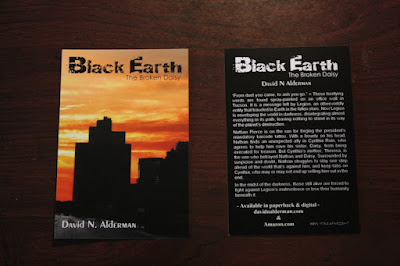
I then hand these postcards out to everyone that walks in the door of the book store. I ask them to check out my book as I hand them one. Usually they keep walking because they are usually at the book store for a specific reason. I tell them the reason for the postcard is so they can wander the store and check out my book while they're at it.
I know some will say that I should be handing copies of my book to people to wander through the store with, but since I'm self-published and my book is not on the shelf of most of these book stores yet, I don't want to risk my book getting lost somewhere in the store, shelved somewhere I'll never find, or possibly walked out with. If they come back to my table and ask me about the book, then I hand them a copy to flip through.
Bookmarks are created somewhat the same way. I use a section of the book's front cover for the front of the bookmark and include my website somewhere on there. I don't have anything on the back of my bookmark just because it saves me money on printing not to have it double sided, although if you have the funds, a double sided bookmark gives you more space to include more info about your book or you as an author.
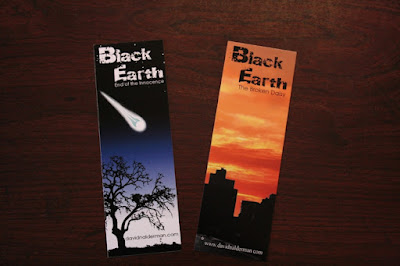
The bookmarks are one of the promotional materials I send to the store ahead of my signing so they can put them at their registers for customers to grab. I usually mail the store the bookmarks, and fliers announcing my arrival, at the same time. * I'll be covering fliers in another blog post. I stick a bookmark in each book as they are sold, and I also keep a stack of bookmarks out on my table so people can grab them and stick them in whatever book they're reading other than mine.
Bookmarks and postcards are relatively cheap, especially if you take advantage of discounts, and if each piece is printed with your website and book info, you're good to go in spreading word about your book. Think of them as business cards but for your book. :)
This is definitely an area that I am working on in my life and my career. Having face time with readers, with your community, with a book store, is essential and can be fun and help to progress your career as a writer. The tools of a book signing are many, and if you know what they are ahead of time then you can prepare yourself for a fun and successful time.
The first tool I want to go over is bookmarks and postcards. For my printed needs, I use PSPrint. They do a great job, have fast shipping times, and their prices are affordable. *At the writing of this post, they are having another one of their sales on postcards - 60% off.
Now, for my postcards, I usually use the front cover image of my latest book for the front and then I put the back cover copy of the book on the back. On the back, I include where my book is available (my website and Amazon.com), my website address, and the ISBN # of my book so your readers can find it anywhere online or in their local book store. This is personal preference, but I choose to keep my book's price off most of my printed promo materials. Sometimes if they find my book on Barnes and Noble or Amazon, my book will be on sale, so I'd rather that be the price they see.


I then hand these postcards out to everyone that walks in the door of the book store. I ask them to check out my book as I hand them one. Usually they keep walking because they are usually at the book store for a specific reason. I tell them the reason for the postcard is so they can wander the store and check out my book while they're at it.
I know some will say that I should be handing copies of my book to people to wander through the store with, but since I'm self-published and my book is not on the shelf of most of these book stores yet, I don't want to risk my book getting lost somewhere in the store, shelved somewhere I'll never find, or possibly walked out with. If they come back to my table and ask me about the book, then I hand them a copy to flip through.
Bookmarks are created somewhat the same way. I use a section of the book's front cover for the front of the bookmark and include my website somewhere on there. I don't have anything on the back of my bookmark just because it saves me money on printing not to have it double sided, although if you have the funds, a double sided bookmark gives you more space to include more info about your book or you as an author.

The bookmarks are one of the promotional materials I send to the store ahead of my signing so they can put them at their registers for customers to grab. I usually mail the store the bookmarks, and fliers announcing my arrival, at the same time. * I'll be covering fliers in another blog post. I stick a bookmark in each book as they are sold, and I also keep a stack of bookmarks out on my table so people can grab them and stick them in whatever book they're reading other than mine.
Bookmarks and postcards are relatively cheap, especially if you take advantage of discounts, and if each piece is printed with your website and book info, you're good to go in spreading word about your book. Think of them as business cards but for your book. :)
Subscribe to:
Posts (Atom)